Choosing between WordPress and a custom website is not simply a question of which technology is better. Both approaches can work well, but they suit different businesses and different requirements. Understanding the advantages and limitations of each can help you make a better decision before development begins.
WordPress and Custom Websites Are Not the Same Thing
WordPress is a content management system that allows businesses to create and manage website content without building every part of the system from scratch.
A custom website is developed specifically around the requirements of the business. The developer has more control over how the website works, how its features are implemented and how different systems interact with each other.
Neither approach is automatically the right choice. The better option depends on what the business needs the website to do.
WordPress Can Be a Very Good Choice for Many Businesses
WordPress is popular for a reason. It provides a mature content management system, a large ecosystem of themes and plugins and a familiar administration experience.
A business can use WordPress to manage pages, blog posts, images and other content without needing a developer every time a simple change is required.
For a company that needs a professional website with standard business features, WordPress can provide a practical starting point without the cost of developing an entire content management system from the ground up.
Where WordPress Can Become More Complicated
The flexibility of WordPress also comes with choices. A website may depend on a theme, several plugins, third-party services and custom modifications.
Each additional component can introduce another dependency that needs to be maintained.
Plugin conflicts, outdated software, unnecessary features and poorly written customisations can also affect security, performance and reliability.
This does not mean WordPress is inherently slow or insecure. It means that the quality of the implementation and ongoing maintenance matters.
Actionable Tip
Do not choose WordPress simply because someone tells you it is cheaper. Ask what your website actually needs and whether the proposed setup will remain practical as your business grows.
What Does a Custom Website Actually Mean?
A custom website is developed around the specific requirements of a business rather than relying entirely on an existing website platform and its standard extensions.
This does not necessarily mean that every line of code is written from scratch. Developers can use established frameworks, libraries and other tools while still building the application's functionality specifically for the project.
The important difference is the level of control over the website's structure and functionality.
Custom Development Gives You More Control
A custom website can be designed around the exact processes a business needs.
For example, a company might need a booking system, customer accounts, quotation workflows, payment integration, an internal dashboard or a connection to another business system.
Instead of trying to adapt several existing plugins to perform the required tasks, a developer can build the functionality around the actual workflow.
This can make sense when the website is an important part of how the business operates rather than simply being an online brochure.
Custom Does Not Automatically Mean Better
It is important to be honest about this. A custom website is not automatically better simply because it is custom.
Poorly written custom software can be difficult to maintain, insecure or unnecessarily complicated. A developer can also spend time building features that an established platform already provides reliably.
If a business only needs a straightforward company website, building a completely custom content management system may create unnecessary cost and complexity.
Good development is about choosing the simplest approach that solves the actual problem.
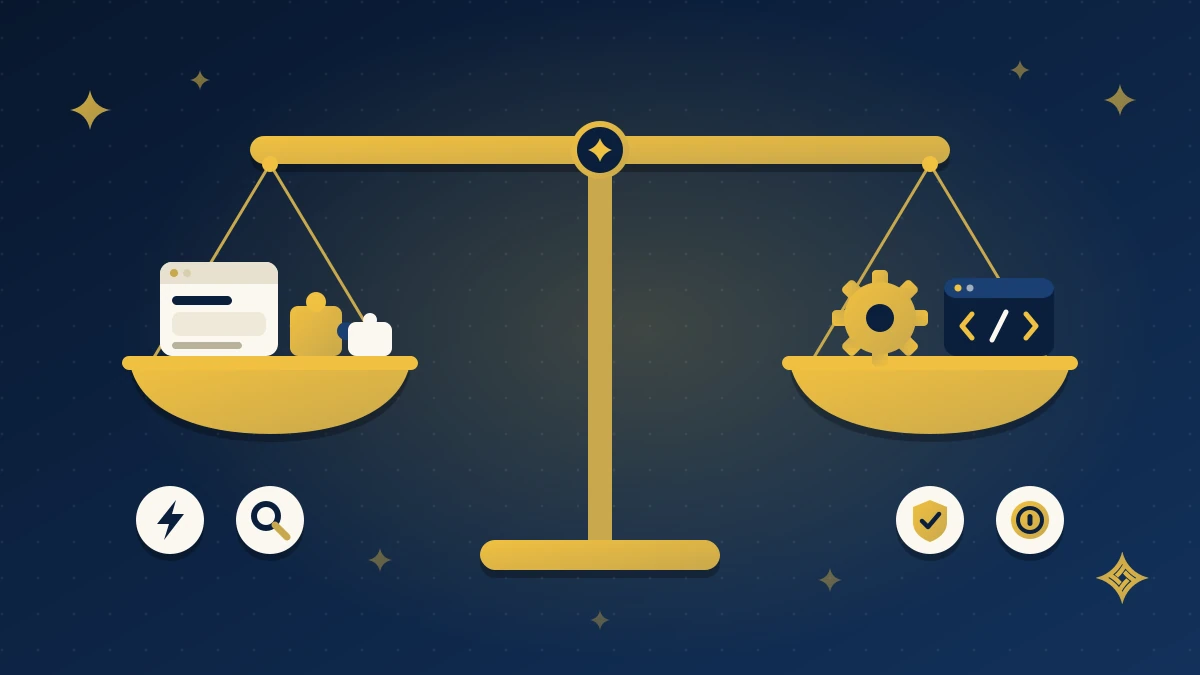
WordPress vs Custom Website: A Simple Comparison
| Area | WordPress | Custom Website |
|---|---|---|
| Initial development | Often faster for standard websites | Usually requires more development work |
| Flexibility | High, especially with plugins and custom development | Very high and built around the project requirements |
| Content management | Built in and widely supported | Can be built around the business requirements |
| Plugins and extensions | Large ecosystem | Usually fewer external dependencies |
| Maintenance | Requires updates for WordPress, themes and plugins | Depends on the technology and development approach |
| Specialised functionality | May require several plugins or custom development | Can be designed specifically around the required functionality |
| Long-term flexibility | Strong for many common business requirements | Strong when the system needs to evolve in a specific direction |
What About Website Performance?
One of the most common arguments against WordPress is that it is slow. That is an oversimplification.
A well-built WordPress website can perform very well. Problems usually come from factors such as large images, excessive plugins, heavy themes, unnecessary scripts, poor hosting and inefficient configuration.
Custom websites can also have performance problems. Poor database queries, inefficient code, excessive requests or unsuitable hosting can slow down a custom application just as easily.
Performance is therefore more about implementation than simply choosing WordPress or custom development.
If your website is already struggling with speed, our web development services can help identify and address performance problems rather than assuming the platform itself is the problem.
What About SEO?
WordPress can support strong SEO. It provides a solid foundation for publishing content and can be extended with tools that help manage important SEO settings.
A custom website can also perform extremely well in search engines when it is developed with a good technical structure.
Search visibility does not come from choosing WordPress or custom development alone. Content quality, website structure, page performance, internal linking, mobile usability, search intent and technical SEO all matter.
If organic search is an important part of your marketing strategy, our SEO services can help make sure the website is built and optimised around the searches that matter to your business.
Security Depends on How the Website Is Managed
WordPress websites need to be kept up to date. WordPress itself, themes and plugins can all require security updates.
Custom websites also require security maintenance. Dependencies need to be updated, vulnerabilities need to be addressed and access controls need to be reviewed.
There is no platform that removes the need for responsible security practices.
The important question is whether someone is responsible for keeping the website secure after it has been launched.
Think About Who Will Manage the Website
If your team regularly publishes articles, changes service information or updates products, the administration experience matters.
WordPress provides a mature administration system that many business owners already understand.
A custom website can also include an administration system designed specifically around the business. This can sometimes make complex workflows easier because the dashboard only contains the functions the business actually needs.
Before choosing an approach, think about who will manage the website and what they will need to do.
Consider the Long-Term Cost
Looking only at the initial development price can give you the wrong picture.
A WordPress website may have lower initial development costs, but the business may later pay for premium plugins, maintenance, hosting, security and custom changes.
A custom website may require more investment at the beginning, but the business may have greater control over the system and fewer unnecessary dependencies.
The right comparison is therefore the total cost of owning and maintaining the website, not simply the first invoice.
Which Option Should Your Business Choose?
Choose WordPress when you need a standard business website. It can be a practical choice when your requirements are well supported by the platform and its ecosystem.
Consider custom development when your requirements are specialised. Custom development can make sense when the website needs unique workflows, integrations or functionality.
Choose based on the business problem. Do not choose a technology simply because it is popular or because another company used it.
Consider who will manage the website. The administration experience should suit the people responsible for maintaining the content.
Think about the future. Consider how the website may need to change as the business grows.
The Developer Matters More Than the Platform
Two businesses can use the same platform and end up with completely different websites.
One may be fast, secure, easy to manage and well structured for search. The other may be slow, difficult to update and filled with unnecessary features.
The difference often comes down to how the website was planned, developed and maintained.
This is why you should spend as much time evaluating the development company as you do comparing technologies.
WordPress or Custom Website?
There is no universal winner.
WordPress is a strong option for many businesses because it provides a mature content management system and a large ecosystem of tools. It can be particularly suitable when the website has relatively standard requirements.
Custom development becomes more attractive when the website needs specialised functionality, unique workflows, deeper integrations or greater control over how the system operates.
The best website is not the one with the most impressive technology. It is the one that gives the business the functionality, performance, flexibility and maintainability it actually needs.
The right technology is the one that solves your business problem without creating unnecessary complexity.
Making the Decision
Before choosing WordPress or custom development, write down what your website actually needs to do.
Think about the pages you need, who will manage the content, how customers will contact you, whether you need online payments or other integrations and how the website may develop in the future.
Then compare the options against those requirements.
If a simple WordPress website can do the job properly, there may be no reason to build something more complicated. If your business requires functionality that needs extensive workarounds, custom development may be the more practical long-term option.
The goal is not to choose the most expensive solution. It is to choose the solution that makes sense for your business.
Frequently Asked Questions
Neither is automatically better. WordPress can be an excellent choice for many businesses, while custom development can make more sense when a website requires specialised functionality or greater control.
Custom development usually requires more initial development work, so it can cost more. However, the actual cost depends on the website's requirements and the amount of custom functionality needed.
Yes. WordPress can support strong SEO when it is properly configured and the website has good content, structure, performance and technical implementation.
Not automatically. A well-built WordPress website can be fast, while poorly developed custom code can also be slow. Performance depends on how the website is built, hosted and maintained.
Custom development can make sense when a business needs functionality, workflows, integrations or a level of control that an off-the-shelf CMS setup cannot provide efficiently.